
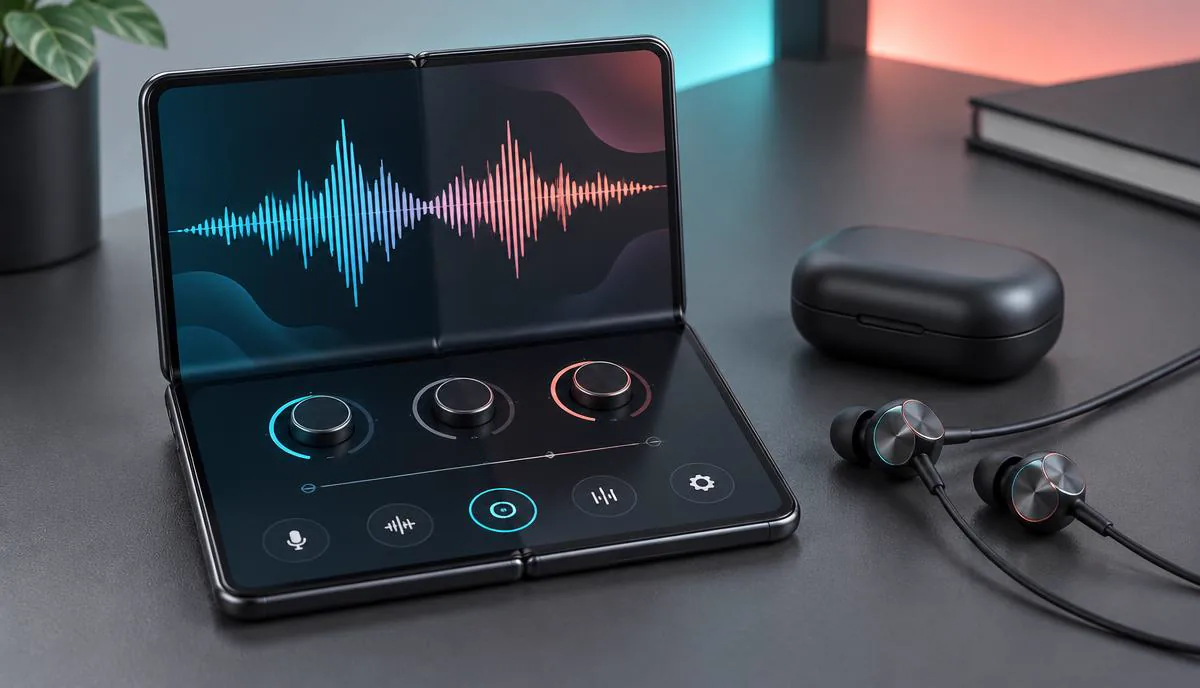
The iPhone Duo is Apple's first foldable phone, but the most important question for voice changing has little to do with its hinge. A bigger inner display can make a voice library easier to browse while you call or play, yet the audio still travels through iOS. That means an iPhone Duo voice changer must solve the same microphone-routing problem as every other iPhone.
This is a pre-release compatibility assessment, not a hands-on review. Apple announced the phone on September 9, 2026, while retail availability starts October 23. We separate confirmed specifications from reasonable iOS-based expectations, then list exactly what early buyers should test after launch.
What Apple has confirmed about iPhone Duo
Apple's iPhone Duo announcement describes a titanium foldable design with a 5.4-inch outer display and a 7.6-inch inner display. Apple also lists the A20 Pro chip, storage from 256GB to 2TB, and Night Sky and Star White finishes. The phone starts at $1,999, with pre-orders opening October 16 and availability beginning October 23, 2026.
Those facts help with purchasing, but they do not prove accessory compatibility. Apple's technical specifications should be the reference for ports, wireless standards and supported audio formats. A processor name or screen size cannot tell us whether a particular headset microphone will be selected correctly during a carrier call.
| Detail | Confirmed before launch | Why it matters for voice changing |
|---|---|---|
| Foldable displays | 5.4-inch outer and 7.6-inch inner screens | More room for controls, but no new microphone permission |
| Chip | A20 Pro | Plenty of processing power; app access remains governed by iOS |
| Release | Pre-order October 16; ships October 23, 2026 | Retail hardware cannot be fully tested before availability |
| Accessory behavior | Not established by screen or chip specifications | Needs a real call, app and microphone-routing test |
Transparency note: no claim in this guide should be read as a completed test on a retail iPhone Duo. Confirmed Apple facts, iOS-based expectations and post-launch tests are intentionally kept separate.
Why the foldable design does not change microphone access
Opening the phone can change its layout, not its security model. iOS apps remain sandboxed: an app may capture your microphone for its own recording or call, but it cannot create a system-wide virtual microphone for the Phone app, FaceTime or another calling app. The outer and inner screens are two views of the same protected audio system.
That distinction rules out a common assumption. Running a voice changer on one side of the large display and FaceTime on the other does not create an audio bridge between them. Multitasking controls where apps appear; it does not grant one app permission to rewrite another app's live microphone stream. The broader options are explained in our guide to voice changers for iPhone.
The audio path matters more than the screen mode
For a live effect, processing must occur before audio reaches the calling app or inside the calling app itself. A recording editor acts too late. A second app running beside the call lacks access. Hardware can act earlier in the chain, while a filter built directly into a game or social app can act inside its own permitted space.
Voice changer options that should work on iPhone Duo
There is no single yes-or-no answer because products labeled “voice changer” do different jobs. Choose by destination: a saved clip, one supported social app, an internet call placed by a special service, or a live microphone that follows you between apps.
| Option | Expected use on iPhone Duo | Main limitation |
|---|---|---|
| Dubbing AI Voice Changing Earbuds | Should provide a changed microphone signal to multiple apps | Exact connection and mic selection require post-launch testing |
| Recording editor | Record, transform and export clips | Cannot alter a live conversation |
| Built-in app filter | Works inside the app that provides the effect | Does not carry into Phone, FaceTime or another game |
| VoIP voice service | May change outgoing calls placed through its own service | Uses that service rather than your normal carrier audio path |
Recording apps remain useful for videos, voice notes and content production. They are not failed live-call tools; they are a different category. Likewise, a game with its own character filter may work perfectly in that game. Problems begin when a listing implies that an ordinary App Store download can take over the microphone in unrelated apps.
Calls, FaceTime, Discord and mobile games compared
The likely result varies by communication channel. The matrix below applies established iOS behavior to the announced phone, but every row involving external hardware remains provisional until the retail model can be tested.
| Scenario | Dubbing AI Earbuds route | Software-only route | Launch-day check |
|---|---|---|---|
| Carrier Phone call | Expected to work if iOS selects its microphone | No system-wide third-party mic filter | Confirm both outgoing audio and monitoring |
| FaceTime Audio or Video | Expected to use the selected headset mic | Only effects Apple provides inside FaceTime | Test folded and unfolded states |
| Discord voice chat | Expected through normal audio input selection | Only Discord-supported processing or features | Check channel input and echo |
| Mobile game chat | Expected if the game honors the connected microphone | Only when the game includes its own effect | Test squad chat, push-to-talk and reconnects |
| Recorded clips | Optional | Yes, with an editor | Check export quality and synchronization |
If your only need is a changed recording, use an editor and avoid buying hardware. If you need live carrier calls, FaceTime and several chat apps, compare products by where they process audio. Our detailed iPhone call app compatibility guide explains why VoIP dialers and recording tools produce such different results.
Using Dubbing AI Earbuds with iPhone Duo
Dubbing AI Earbuds process speech in the accessory before passing it to the phone. That architecture is relevant because iOS should receive an already changed microphone signal rather than being asked to let one app inject audio into another. As of September 2026, the earbuds support iOS and Android, include 500+ voices, and process at about 300 ms latency.
What we can confirm today is how the earbuds work with current supported phones. What we cannot confirm before October 23 is the exact iPhone Duo connection behavior, microphone priority, call monitoring level or whether folding the device triggers an audio-route reset. Those points require a production phone, not a specification sheet.
Expected connection flow after launch
- 1Connect the earbuds using the iPhone Duo's supported audio connection and confirm iOS shows them as the active audio device.
- 2Open the Dubbing AI companion app, choose a voice and speak into the earbud microphone.
- 3Call a second phone first; ask the listener to confirm that the changed voice, not the handset microphone, is arriving.
- 4Repeat the check in FaceTime, Discord and one game because each app can handle audio-route changes differently.
- 5Fold and unfold the phone during a test call, then verify that microphone selection and monitoring remain stable.
Explore voice-changing hardware for iPhone
See how Dubbing AI Earbuds process 500+ voices before audio reaches your apps, with support for iOS and Android.
View Dubbing AI EarbudsWhat to verify when the phone ships
Early adopters should treat compatibility as a checklist, not a single pairing badge. Bluetooth playback can succeed while the phone quietly keeps using its own microphone. A voice may work in a recording and fail after a call app reconnects. Testing both sides of a conversation catches those false positives.
- Confirm that iOS identifies the accessory and selects its microphone, not only its speakers.
- Record a short Voice Memo, then make a carrier call to a second device and compare what arrives.
- Test FaceTime, Discord and your main game separately; do not assume one successful app proves every app.
- Fold and unfold during an active call to catch microphone switching or a dropped audio route.
- Reconnect after locking the screen and after restarting the phone.
- Judge 300 ms processing in a real conversation or squad call, not only by watching an on-screen meter.
Keep the phone and companion app updated during the first release weeks. New hardware often receives early software fixes, and repeating this short matrix after an update is more reliable than assuming a pairing result will never change.
Who should wait before buying a voice changer
Wait if iPhone Duo is your only device and guaranteed launch-day operation is essential for work, accessibility or a scheduled broadcast. The phone is not yet available for retail testing, so no responsible accessory maker can promise every audio route today. A short wait for verified results removes that uncertainty.
You should also skip dedicated hardware if you only change prerecorded clips or use a single app with a good built-in filter. Hardware makes more sense when the same live voice needs to travel across calls, chat and games without depending on each app to offer an effect.
Finally, use any changed voice transparently and lawfully. Character play, privacy and entertainment are reasonable uses; impersonating a real person, bypassing voice authentication or obtaining money or access through deception is not. The new form factor may be novel, but the responsibility stays familiar.
Frequently asked questions
Dubbing AI Team
Hardware & Voice AI
We build real-time voice changing hardware for gaming, streaming and calls.